

The cost of bad data is not just a database problem. It is a revenue problem. Every duplicate record, outdated contact, and inaccurate email address is quietly draining your pipeline, slowing your sales cycles, and making your marketing measurably worse.
According to Gartner, poor data quality costs organizations an average of $12.9 million annually. Most enterprises still treat this as something for the IT team to sort out. That is a mistake. This is a business problem, and it is hitting your growth, your forecasts, and your operational efficiency whether you are paying attention or not.
Why the cost of bad data is higher than you think
The financial damage does not show up as a single line item. It shows up as wasted campaign spend, hours lost to prospect research, and sales reps dialing numbers that have been disconnected for months.
There is a principle in data management called the 1-10-100 rule. Verifying a record costs $1. Cleaning it after the fact costs $10. Leaving it uncorrected can cost $110 in wasted operational expenses. The math scales fast.
Bad data also corrupts decision-making at the top. Executives allocate quarterly budgets based on what their dashboards tell them. When the underlying data is wrong, the strategy built on top of it will underperform. Not because the call was bad. Because the inputs were.
- KEY TAKEAWAY
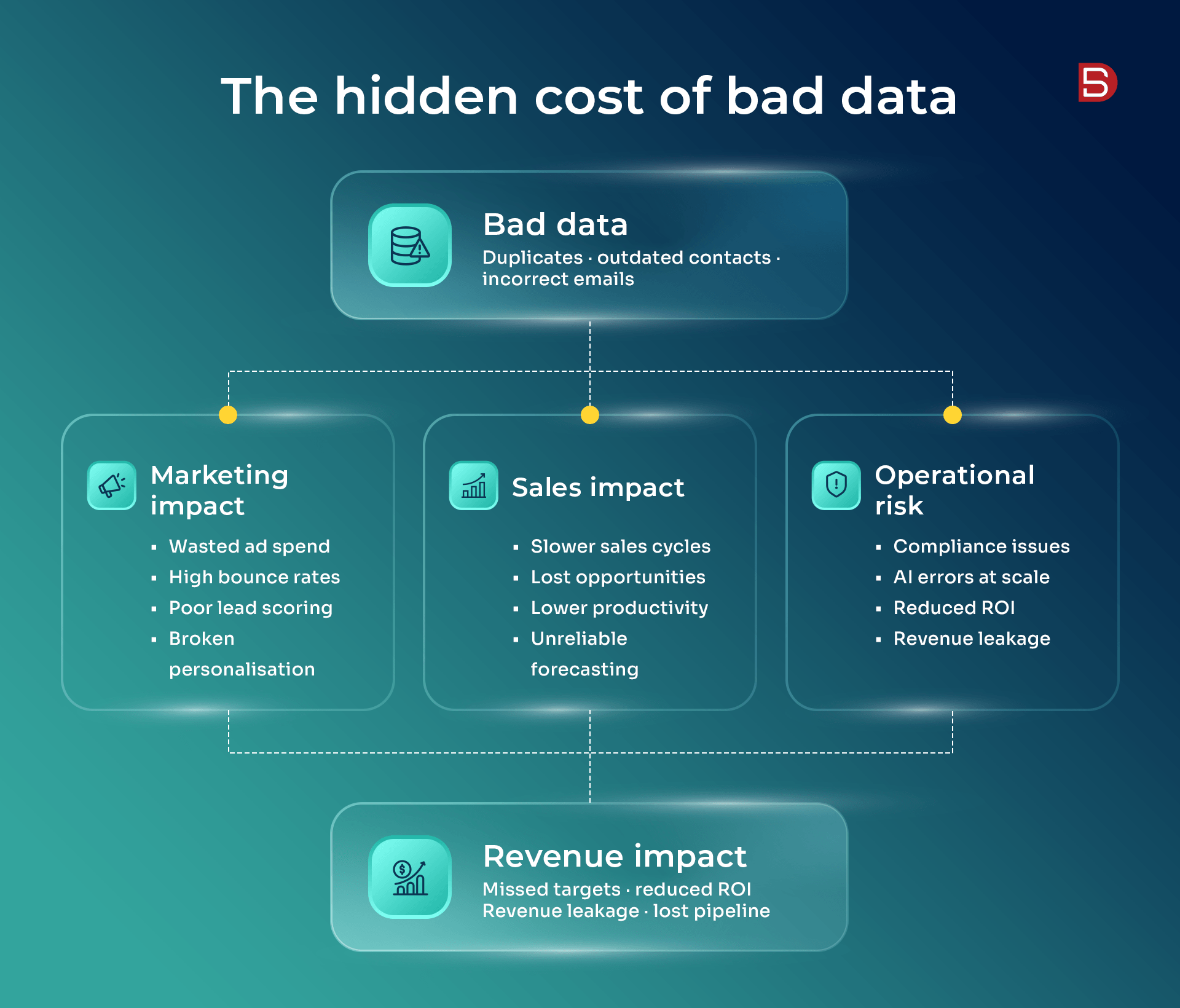
The cost of bad data is not an isolated IT expense. It affects marketing performance, sales productivity, forecasting accuracy, and overall business growth.
How the cost of poor data quality erodes marketing ROI
Demand generation is only as good as the audience data behind it. When data quality degrades, lead scoring models start firing false signals. Teams waste resources chasing dead ends while genuinely qualified prospects go untouched. The financial impact becomes impossible to ignore.
A Harvard Business Review study found that bad data costs US businesses more than $3 trillion per year in total economic value. A significant portion of that loss comes from misdirected marketing spend and damaged sender reputations from high bounce rates.
The fix is not complicated, but it requires consistency. Regular validation and data enrichment correct the underlying records. Clean data means your automated platforms are actually reaching valid accounts. It means your lead scores reflect reality. And it means your campaign spend is going somewhere productive.
Many organizations turn to external database cleansing services when their historical files have degraded too far for internal teams to remediate. It is not an admission of failure. It is the fastest path back to predictable pipeline performance.
- KEY TAKEAWAY
Addressing the cost of poor data quality through structured management directly restores marketing campaign predictability and protects pipeline conversions.
Sales pipeline stagnation and lost revenue opportunities
Sales velocity runs on accurate data. When account executives inherit records with outdated contacts, wrong technology stack information, or incorrect corporate hierarchies, their productivity drops before the first conversation even begins.
Think about what happens when a rep pitches a prospect based on a vendor contract that already renewed six months ago. The opportunity is dead on arrival. That is not a sales problem. That is a data problem that cost a real deal.
The solution requires systematic intervention. Professional data cleansing services standardize field structures, verify corporate hierarchies, and transform what is currently a chaotic CRM into a functional intelligence engine. When data quality becomes a priority, sales forecasts become reliable. Teams can commit to revenue targets with confidence because their pipeline reflects what is actually in the market.
- KEY TAKEAWAY
Regular database cleansing services eliminate pipeline friction, allowing sales professionals to maximize active selling time and improve win rates.
Mitigating operational risk with data quality management
Bad data is also a compliance liability. Regulations including GDPR, CCPA, and India’s Digital Personal Data Protection Act require organizations to manage personal information responsibly. Inaccurate or outdated records increase the likelihood of accidental violations, and the penalties for those violations are not hypothetical.
There is a second risk that tends to get less attention. AI-powered workflows amplify whatever is in the underlying data. Feed a predictive model bad inputs and it produces confidently wrong outputs at scale. The automation does not catch the error. It accelerates it.
Reducing these risks requires a proactive data quality management framework: clear data ownership, standardized validation protocols, and continuous monitoring. That framework turns your data from a liability into a genuine enterprise asset.
- KEY TAKEAWAY
Robust data quality management mitigates regulatory risk and ensures that automated enterprise systems deliver accurate, scalable outcomes.
Optimizing enterprise revenue with Datamatics Business Solutions
Most organizations reach a point where the internal team cannot remediate the damage fast enough. The records are too far gone, the backlog too deep. That is where specialist support changes the equation. DBSL helps enterprises validate, enrich, and standardize complex B2B datasets through dedicated cleansing and optimization services, so sales and marketing teams are working from data that actually reflects the market.
Ready to turn data into revenue?
Bad data does not announce itself. It just quietly takes money off the table. If your campaigns are underperforming, your pipeline is stalling, or your forecasts keep missing, the data is worth looking at first. Discover how DBSL can help you improve data accuracy, strengthen pipeline performance, and turn better data into better business outcomes.
- FAQS
Frequently Asked Questions
1. What are the main causes of bad data in an enterprise database?
Enterprise data decay typically stems from manual entry errors, disparate software integrations, and natural information aging. Corporate structures change rapidly as professionals switch companies, change job titles, or modify corporate email formats. Without automated validation, an enterprise database naturally degrades at a rate of approximately 2 to 3 percent per month.
2. How does data cleansing improve marketing automation performance?
Data cleansing services remove duplicate records, correct formatting anomalies, and validate contact details. This maintenance ensures that marketing automation platforms route leads correctly and trigger campaigns accurately. Clean databases prevent email compliance blocks, reduce platform licensing costs, and improve lead scoring accuracy.
3.What is the distinction between data cleansing and data enrichment?
Data cleansing focuses on identifying and correcting errors, duplicates, and outdated entries within an existing dataset. Data enrichment inserts missing contextual information, such as revenue figures, employee counts, or technology stack details, into those clean records. Together, they turn raw contact lists into actionable business intelligence.
4. How do you measure the financial return of data quality management?
Organizations calculate the return on investment by tracking specific operational metrics before and after data optimization. Key performance indicators include reductions in email bounce rates, decreases in sales prep time, and improvements in lead-to-opportunity conversion rates. Lower data infrastructure costs and minimized regulatory risks also contribute to total financial return.